Facebook
 X
X
 Pinterest
 Copy Link
Happy New Year! I wish you health, happiness, and success in all your 2026 endeavours.
The December market data has now been released. Below, I’ve highlighted a few key takeaways, and further down in this email you’ll find charts and more detailed breakdowns by location and property type. If you’d prefer a more tailored, “zoomed-in” view of your specific neighbourhood or property segment, feel free to call me anytime.
From what I’m seeing on the ground, activity is slowly picking up. I’m currently working with several buyer prospects, a strong number of lease inquiries, and I’m seeing increased interest in multi-unit commercial and residential properties. There have been a few recent offers on investment-style properties over the past couple of months, although many have not yet come together for various reasons.
Overall, consumer confidence appears to be improving, but buyers remain cautious on pricing. At the same time, listings are sitting on the market when sellers are not closely aligned with current market expectations. Pricing accuracy is proving critical.
I’m also speaking with several potential sellers who are trying to time the market. A common question is whether to list now—when there may be fewer competing listings and a chance to stand out—or wait for the spring market, which typically brings more buyers, but also significantly more seller competition. Some are weighing whether prices could soften further between now and spring, making an earlier listing more appealing.
Looking ahead, some market forecasters are projecting modest price declines in 2026—approximately 3.5% nationally and closer to 4.5% in Toronto, according to two major national brokerages. This year is also when many have predicted a potential “mortgage renewal shock,” as homeowners who secured historically low rates face renewal at higher levels.
That said, I’m not convinced this will result in a large flood of listings. Many homeowners who bought 4–5 years ago also sold at peak values and put substantial equity down when purchasing, unless they were first-time buyers. In addition, a surprisingly large number of Ontario homeowners are mortgage-free, particularly among long-term and older owners. For those with mortgages, I believe many will adjust to higher payments rather than sell—especially given that selling often means renting or significantly downsizing at today’s prices.
As a result, I expect many owners will look for alternative solutions to maintain their homes, such as refinancing, adding a second mortgage, bringing in a roommate, or adjusting other expenses, rather than being forced to sell.
There are also signs of improving conditions ahead. Compared to last spring, economic uncertainty has eased, pricing is more affordable, interest rates have come down from last year’s peak following multiple hikes, and increased inventory is creating more competition among sellers. Some economists are also pointing to potential stimulus later in 2026, including further rate reductions, possible government incentives, and improved employment and inflation data.
The foreign buyer ban is currently set to expire at the end of 2026, and any adjustments or removal could also stimulate investment activity. There has also been discussion around revisiting the mortgage stress test requirements, which could further impact affordability. Many of these factors point more toward 2027 as a potential inflection point.
It’s fair to say the past few years have been stagnant and, at times, confusing for buyers and sellers alike. Historically, real estate markets move in cycles of peaks and valleys, and many are trying to identify whether we are at—or near—the bottom. Some seasoned market observers suggest we may be close, making this a compelling time to buy, while others believe there may still be some room to the downside into 2027.
One statistic I’ve seen shows an average price decline of approximately 26% from the February 2022 peak. Considering how sharply values rose during the pandemic, this correction is not unexpected—and we are still above pre-pandemic pricing levels.
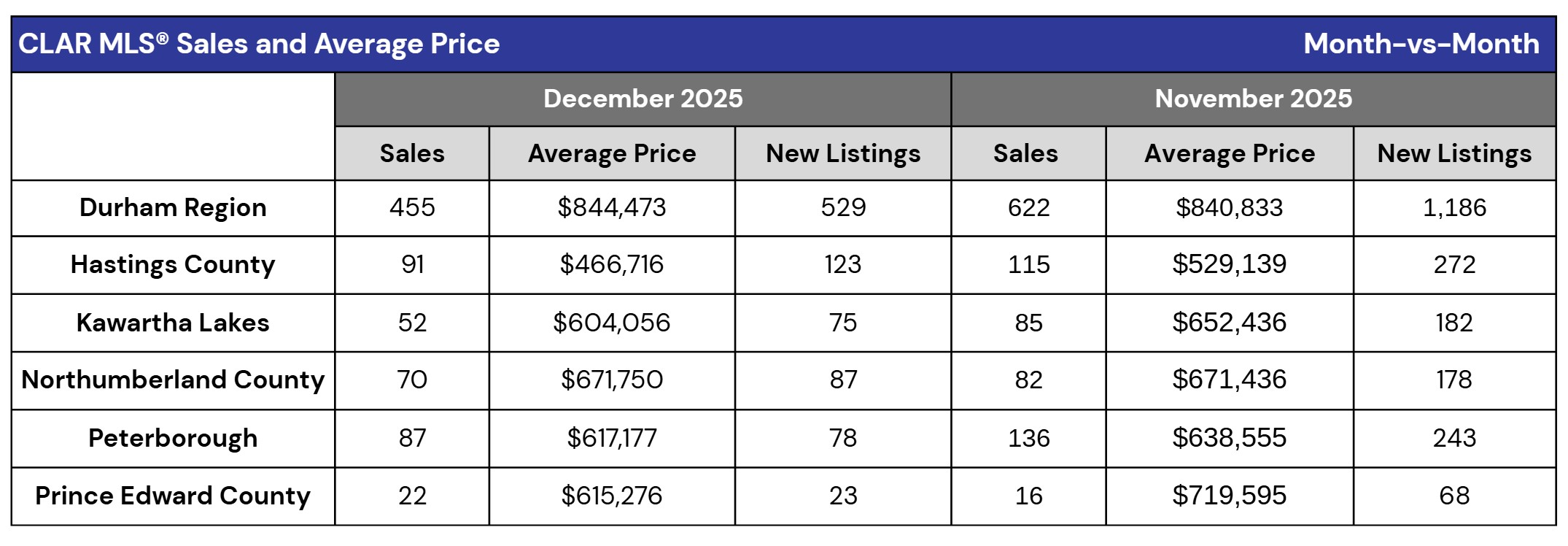
Below is a snapshot of the latest data, with more detail further down in the email.
As always, please don’t hesitate to reach out if you’d like to discuss buying, selling, leasing, or simply navigating the current market.
Warm regards,
Denise
Northumberland County recorded 70 home sales in December, a 14.6% decline compared to November’s 82. The average selling price edged up slightly to $671,750, remaining stable relative to November’s $671,436, highlighting consistent pricing conditions. New listings totalled 87, while homes spent an average of 54 days on the market, remaining largely in line with last year’s 57.
Durham Region recorded 455 home sales in December, down from 622 in November, reflecting typical year-end seasonality. The average selling price increased modestly by 0.4% month-over-month to $844,473, demonstrating continued price stability. Compared to December 2024’s average of $930,207, pricing reflects a more balanced market environment. New listings totalled at 529, an increase of 8.9% from last year’s 486, with homes spending an average of 38 days on the market.
(charts and more detailed data for all areas in the Central Lakes Association of Realtors board below)
|

|
|

|
|

|

|
|